FILM
As a young woman studying art in Soviet Russia, did you encounter any particular difficulties?
Olga Survillo: Yes, when I first applied to the VGIK production-design department, I was not accepted straight away – at that time it was considered a “male” profession involving long shooting periods far from home and hard construction work. For the first three years, I had to study in the animation department, but I eventually managed to convince the committee of my suitability and was transferred to Alexander Borisov’s studio, one of the finest film designers and teachers of that era. He introduced us to the Surrealists and to contemporary Western painting trends that were otherwise almost inaccessible.

What were the most valuable skills you gained at the VGIK Faculty of Production Design?
OS: I loved the freedom to rearrange objects according to the task at hand – creating the right atmosphere or reconstructing the living environment of different characters. The best part was that nothing was permanent: unlike real architecture, everything existed only for the duration of the shoot and was then dismantled and thrown away. I learned numerous ways to convincingly imitate materials. Every year, we also spent two months on location – painting from life, gathering visual material for future sketches – in Latvia, Georgia, on actual film sets.
How did the VGIK curriculum combine traditional fine-art techniques with cinematic storytelling?
OS: The goal was to achieve a unified and instantly recognisable visual world – a single frame had to be identifiable as belonging to that particular film. In those years, to get a film green-lit, the production designer had to present finished sketches for every key scene, and a complete storyboard worked out together with the director and cinematographer. We were trained to draw in such a way that everyone on the crew could immediately understand what a given object or environment was made of, to feel its texture.
Which projects or assignments at VGIK proved decisive for your artistic development?
OS: For our course and diploma films, we were required to adapt works by Soviet authors. There were few truly strong Russian texts available, and the best ones were quickly taken. That deficit helped me to discover contemporary Georgian literature. For my diploma, I chose the novel The Law of Eternity by Nodar Dumbadze – its texture resonated with me, and its themes (Stalin-era repressions) echoed my own family history. Georgian art and cinema of that period had a profound influence on me: simple yet complex imagery, laconic forms, a restrained palette built on brown, black, green, and accents of red, and a profound appreciation for ornament.
How did your training at film school prepare you for a career in production design?
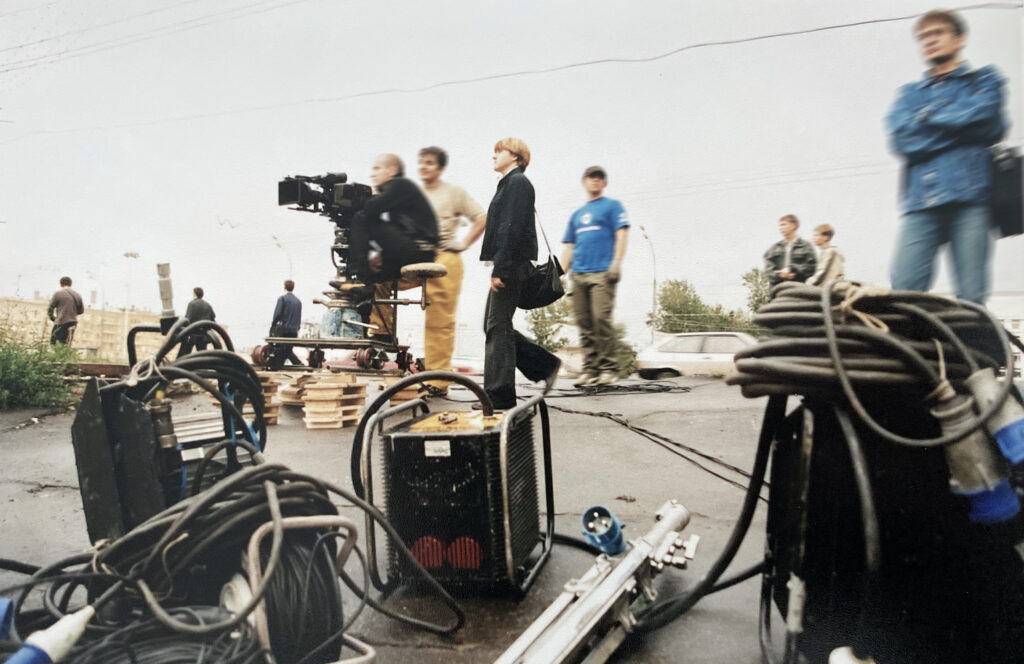
OS: When I arrived at Mosfilm, instead of waiting for my own film, I deliberately took work as an assistant art director under an experienced designer in order to learn even more about the production process. Only later did I receive my own projects, and each one brought new knowledge. By the 2000s, film production had changed radically from a technical point of view; the entire preparatory phase moved onto computers. Storyboards were now digital, and I only picked up a brush again to touch up something directly on set.
Did any specific film project directly influence the themes that later appeared in your paintings?OS: Yes, most notably for the film Zolushka 4×4 (2008), we built an enormous outdoor set almost entirely out of industrial rubber waste – that experience sparked a lasting fascination with rubber, plastic, rubbish bags, and rusted metal. Before that, in Caucasian Roulette (2002), I designed a postal wagon filled with wrapped parcels; my long-standing admiration for Christo and Jeanne-Claude suddenly became practical. There is a special beauty and mystery in objects that are wrapped in kraft paper, ordinary paper, or plastic film – because wrapping transforms their very essence. That sensation has stayed with me and frequently returns in my paintings.