Influences
Which artists, historical or contemporary, have had the greatest influence on your work?
Olga Survillo: From the past: Whistler, Turner, Schiele, Magritte, de Chirico, Ernst, Delvaux. I have also been drawn to hyperrealism and the nineteenth-century trompe-l’œil tradition, and I aspire to approach the spirit of Surrealism. Among more recent artists: Vija Celmins and Domenico Gnoli.
Did Russian artistic traditions, particularly those of the Soviet era, shape your aesthetic in any way?
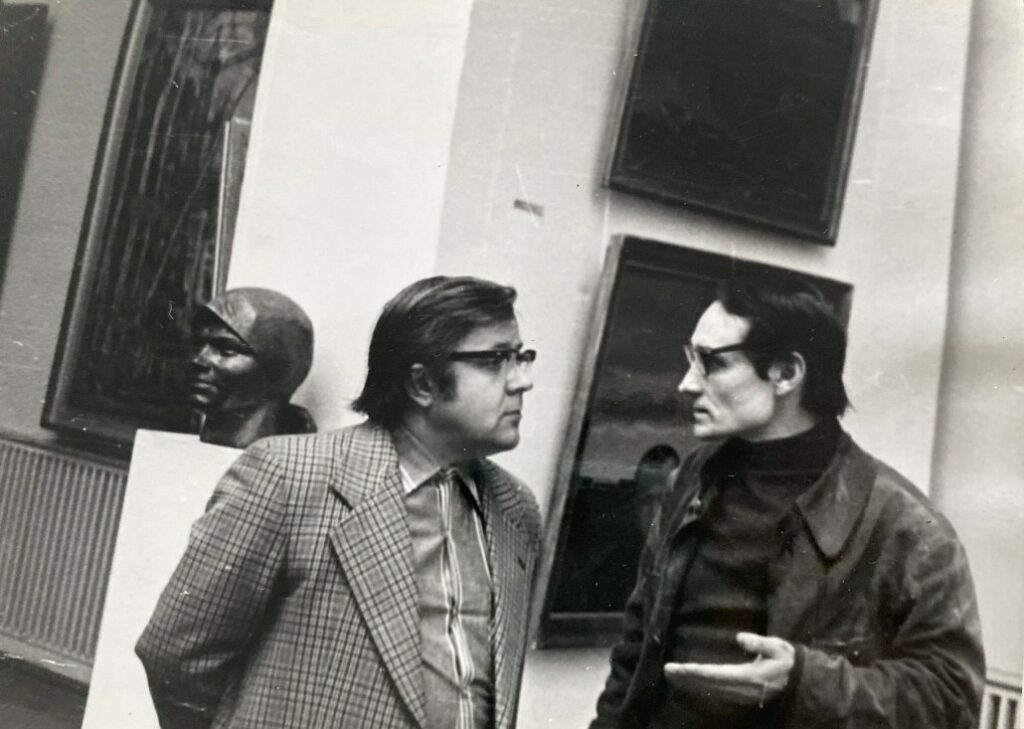
OS: Perhaps only through my father’s watercolours. Soviet art, on the whole, influenced me more by negation—it was either derivative or monotonously grey. Exceptions were certain painters of the so-called Severe Style: Pavel Ossovsky, the Bragovskys, and some works by Gely Korzhev; I admired their draughtsmanship and imagery. Another important figure was the monumental artist Boris Pamyansky, who studied with my parents. I often visited his studio as a child and was fascinated by his paintings and drawings.
Which contemporary artistic movements or artists resonate with your own style?
OS: I find it thrilling to follow the development of younger artists, especially when our themes overlap. Issy Wood, of course—I follow all her projects with great interest. Lately, there has been much exciting work coming from Asian, particularly Korean, artists: Sun Yitian, Jiwon Choi. I am also always drawn to artists that in one way or another engage with the world of cinema, since that topic is so close to me—Bendt Eyckermans, Britta Thie, Lotte Keijzer. In general, I try not to miss openings in Berlin, a city where I have always spent a great deal of time.
Are there directors or cinematic styles that continue to inspire the visual storytelling in your paintings?
OS: When choosing a visual language for a film, one often starts with paintings—taking certain canvases as a reference point. It is an easy way to reach an agreement on the overall look at an early stage. So the influence tends to flow the other way: one draws inspiration from painters. When I watch films by Wenders, Antonioni, Burton or Sorrentino – that is purely for pleasure.
What role do literary or philosophical influences play in your creative process?
OS: They shape the narrative and my attitude toward what I am about to make. I approach each painting as an act—an act that forms part of my own path. The strongest philosophical influence comes from Eastern thought, particularly Chinese and Japanese.