Painting
After more than thirty years working in film as a production designer, what prompted you to fully transition to painting around 2020?
Olga Survillo: On one hand, it was a change of residence; as early as the beginning of the 2010s, I sensed that my Moscow period had come to an end. Another aspect was the nature of the film process itself, which involves multiple contingent elements and inevitable compromises. With time, one craves greater predictability. In painting, you create a relatively compact story, but it is entirely your own—one that truly interests you at that particular stage of life. At the same time, the message the viewer receives can be just as significant as that of a feature film experienced on a large screen.
Were there specific disappointments in the film industry that pushed you toward the solitude of painting?
OS: Film production is always a collaboration between many people. Certain moments became increasingly frustrating, especially when my vision diverged from that of the director or producer. I either had to leave a project or continually defend my ideas—an exhilarating but exhausting process. Now, all dialogues and debates are with myself alone. In the studio, it is just my son and me; the dynamic is entirely different. Discussions with curators and gallerists only arise around finished works, for example, when shaping an exhibition.
What was the first painting you created in your new studio, and what did it mean to you?
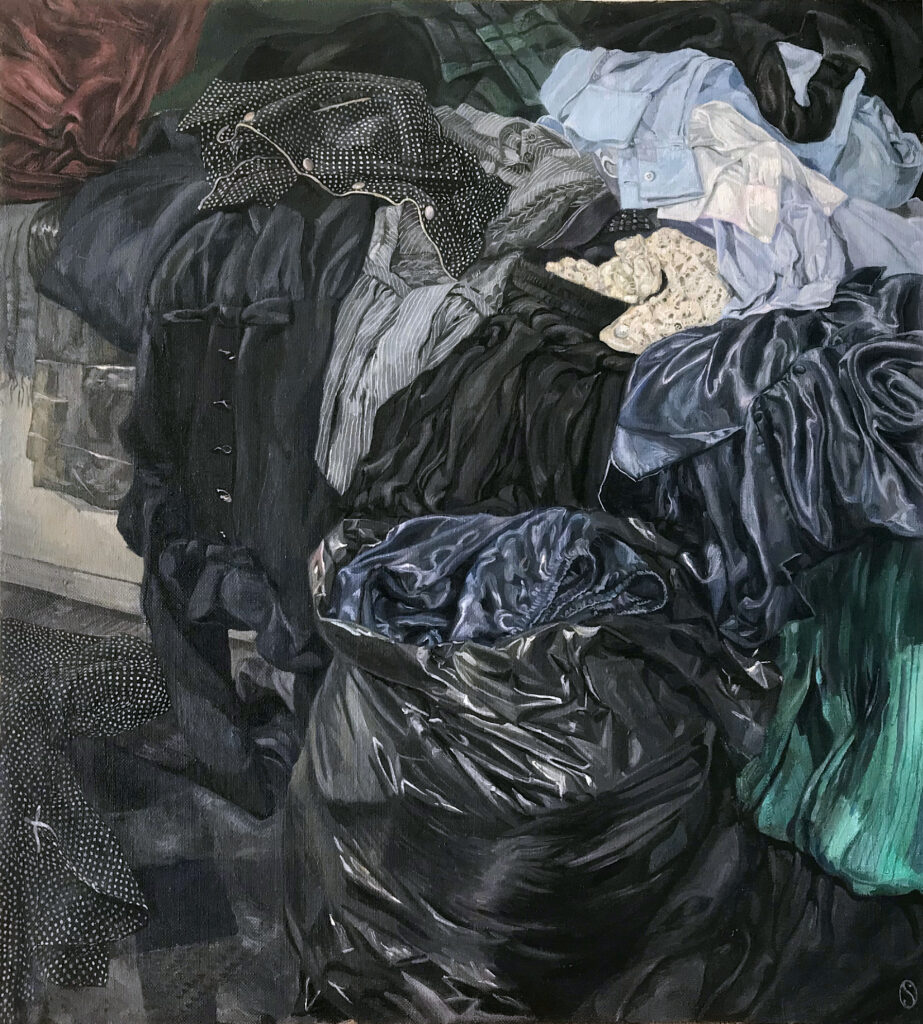
OS: The triptych ‘Garbage’—a pile of useless objects that have no financial value whatsoever, yet have been carefully preserved across generations and miraculously relocated to another country. Heaped together, they form something strangely beautiful, yet ultimately superfluous. But how does one part with them? Everything must be kept, and it all weighs down and suffocates. The same goes for clothes—mountains of clothes… And then one can pack it all into black rubbish bags (the right panel), and that too becomes beautiful in its own way.
Looking back, do you consider your career in film a detour or an essential foundation for your painting?
OS: Everything that happens to a person along life’s path is a valuable experience. Work in film, in particular, was priceless. To this day, for me, each painting is a single frame from a screenplay of my own invention.