Technique
How do you select the subject for a new painting?
Olga Survillo: A constant stream of consciousness flows through us; when a particular object or group of objects catches the eye, an idea emerges. It feels worth telling, worth painting. Over time, countless objects from the material world have accumulated around me—often strange, utterly useless in daily life—yet they sometimes interact in unexpected ways and generate new meanings. One must stay attuned to processes unfolding in contemporary art. Then I make sketches and discuss them with Georg.
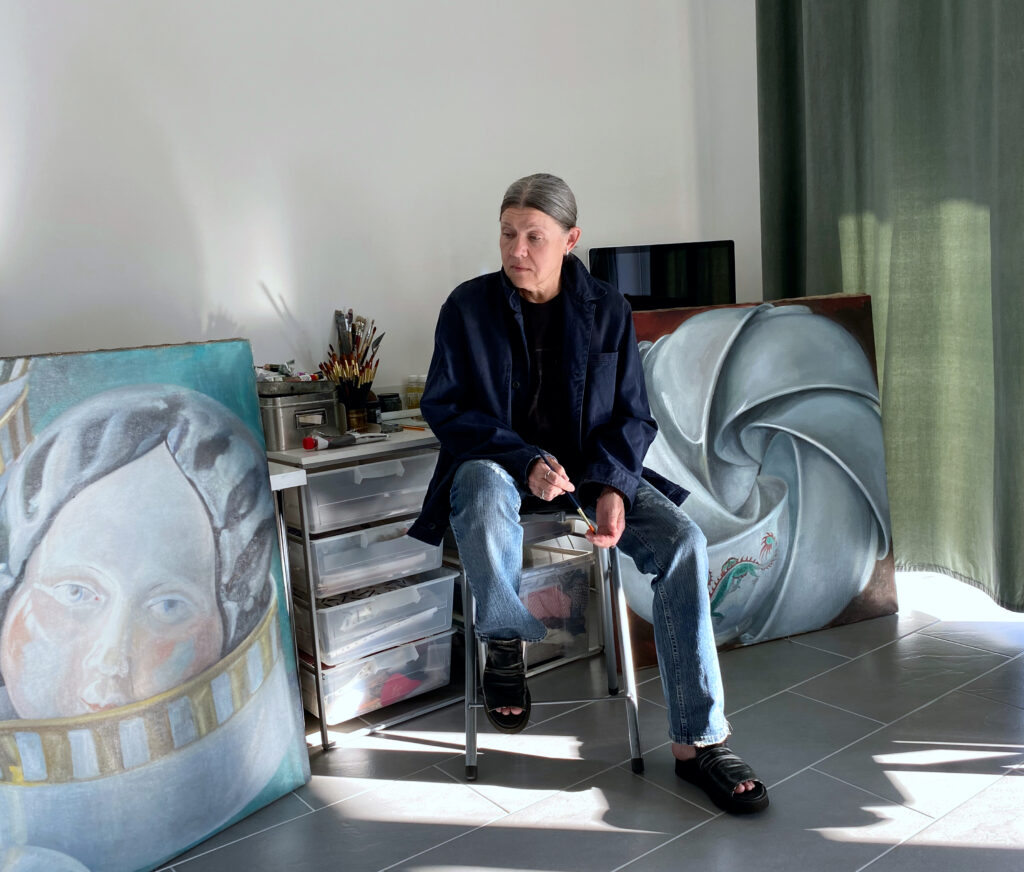
Could you tell us more about your collaborative work with your son?
OS: I believe total isolation is neither right nor entirely productive for the creative process. After decades of team-based, project-driven work in film, it would feel unnatural to me anyway. Now, almost my entire creative process takes place in co-authorship with my son: together we search for themes and objects to depict, and we discuss composition. Georg devotes a great deal of time to analytical work—gathering material, researching ideas and narratives for paintings, and preparing sketches for certain compositions. I feel that a painting which unites the perspectives of different generations gains greater depth. Historically, artists’ studios brought together several generations, but under the conditions of the modern market, that practice seemed to vanish in the twentieth century, replaced by the lone hero (usually, of course, male—though in recent years women are finally coming to the fore). Who knows—perhaps the tradition of family studios will return. We are drawn, for example, to the atmosphere in Bendt Eyckermans’s paintings, many of which revolve around his grandfather’s studio—that sense of continuity and shared labour across generations toward a common result is inspiring.
What role do sketches or preparatory drawings play in your working process?
OS: They are essential to me—I need to “feel out” scale and viewpoint in sketches, sometimes adding colour. This comes directly from my scenography experience: the desire to determine format and scale in advance.
Do you work on several pieces simultaneously, or do you focus on one at a time?
OS: It is better to work on several at once. On one hand, I am always thinking in terms of series, frames, and narrative. On the other hand, when working in oil, it is part of the technique: while one layer dries, I move to another canvas.
Why do you prefer materials such as oil on linen or acrylic on panel?
OS: Oil presents no technical difficulties for me—everything is familiar and predictable; if it does not work today, I will get it right the next day. It is pure pleasure. The same goes for simple pencil, watercolour, and gouache. Acrylic is more challenging: after a few hours, it dries and seems to “tire”; I have to clean the palette, interrupt the flow. It takes longer to reach the desired result, requiring more layers of paint. In its own way, it is interesting—for me, it remains a relatively new material. For a long time, I could not see its potential until I realised it works beautifully on a wooden panel, like an icon; painting acrylic on canvas never felt pleasant to me.

How do you choose a technique to convey particular textures or emotions?
OS: Extended, meticulous modelling, and the softening of touches and edges lend an important quality. Yet quick, emotional brushstrokes—when placed precisely—are fascinating to look at. To achieve depth and multilayered richness, I tend to rely on glazes and endless gentle “rubbing” with the brush—blending, erasing, and working the surface.
How do you find the balance between realism and abstraction in your style?
OS: The most realistic possible rendering of an object, seen from an unexpected angle and placed in unusual interaction with other objects. Things are not always what they seem…
Are there new themes or techniques you wish to explore?
OS: I would like to devote more time to graphic work—traditional etching as well as drypoint, and to become better acquainted with lithography, engraving, and related techniques. I hope the next studio will offer more space for this.
What advice would you give to aspiring painters learning oil technique?
OS: Study painting techniques, prime your own canvases, and try at least to learn a little about the chemistry of pigments and how they behave in combination over time. Train the hand with pencil and stylus sketches—this gives a genuine sense of belonging to the craft. And painting is, above all, a craft. Naturally, computer graphics and AI, as new tools, can assist in searching for solutions and images. The more technical possibilities appear, the broader the range of “palettes” one will need to master.